Gonzalo Benegas is a member of technical staff at Open Athena’s New York office, where he works on DNA models like MarinDNA. In this Q&A, he explains how teamwork makes Open Athena special, compares general-purpose LLMs for science with scientific foundation models like MarinDNA, and champions the gem emoji.
What’s one of your earliest experiences with AI technology?
Gonzalo Benegas: I took a machine learning course in undergrad. At that point, it was pretty close to statistics and modeling data, but over a long time, it's been transforming. AI is much more than machine learning today, and it impacts so many aspects of our lives.
Then I had those first magical moments with ChatGPT. I was asking it to write code, and I was impressed by the level of generalization to new settings. For example, I was writing code for understanding DNA, and it was very useful there.
What drew you to work at Open Athena?
I’ve always really appreciated knowledge. One thing that I value the most throughout my life is that I want to learn from many topics, which I did throughout my education. And when I went into academia, I had that purpose as well. So I'm very grateful for that opportunity.
After I left academia, I thought Open Athena had many really cool aspects. One is, like academia, it also has the goal of dissemination of knowledge. And in fact, perhaps we can do that even faster than academia, because we don’t have a main target of producing peer-reviewed papers that take a lot of time in the review process. We have been able to just do all our development in the open from day one. It just feels right to not hold off the results of experiments. So that is really nice.
The other thing is, I also wanted to work on larger AI models that require more resources, such as compute and different people working together. In academia, you’re working in a much smaller group, but I really wanted to be part of this technology that requires a lot more teamwork.
What Open Athena project do you primarily work on?
For most of the time so far, I've been working on MarinDNA, which is an LLM trained on DNA. This is the most minimalistic language, just A-C-G-T. And that is something that I also worked on before in academia.
Here, we worked on the model using many of the ideas from our general-purpose LLM Marin, applying it to the new domain of genomics. One of the ideas is the understanding of how to scale up models. For example, how to do scaling heuristics, and how to determine the optimal hyperparameters for a large model based on smaller experiments. That idea was really useful, and it felt great to be able to apply it for DNA. I’m also focusing on data curation, which is something that I always felt could be improved and still can. Based on all the infrastructure and knowledge from all the rest of the team, I think we were able to explore scaling and data curation to improve DNA models.
Did you have any experience in this area before you began working on MarinDNA?
I was working on many aspects of DNA models for a couple of years before joining Open Athena, such as how to train a simple model, how to evaluate on variant effect prediction, and so on.
One thing that was new to me is focusing on the standard architecture that was implemented in Marin. Another is how to understand the scaling properties of these models and, fundamentally, how to make sure that you can select the appropriate hyperparameters. Because in the past, I had tried to scale up models by just guessing hyperparameters, and they would be unstable. So I had tried before, but it was only with MarinDNA in particular—thanks to Eric Czech, who really pushed the frontier on this for DNA—that we were able to train larger models.
What sort of work do you do at Open Athena that’s not related to MarinDNA?
Right now, I'm also exploring Marin for Science: how to make the Marin LLM better at understanding biology and DNA. Instead of training a model just on DNA, it's more about adding this understanding of DNA to a generalist model such as Marin.
This is a unique opportunity because there’s no real public knowledge about how to do this. If you observe the closed models, they're getting much better at biology. But in the open, there's not much work on this. For example, there’s no public post-training data for biology, for the most part. I'm really excited about contributing to try to fill this gap.
Several of us are working on this project, and there's so much to do. For example, to begin with, the idea of having general capabilities for doing computational biology work. This is something that current models have been really useful for, like using coding agents. One part of it is making sure that we can adapt those capabilities to Marin. But then we also want to push some specific applications, such as variant effect prediction, with LLMs. And one of the motivations for this is making an LLM that has not only seen DNA, but also understands protein biology, RNA biology, transcriptomics, and the vast literature about specific genes. An LLM is a natural system to integrate all this information. That is one of the things that I'm excited about.
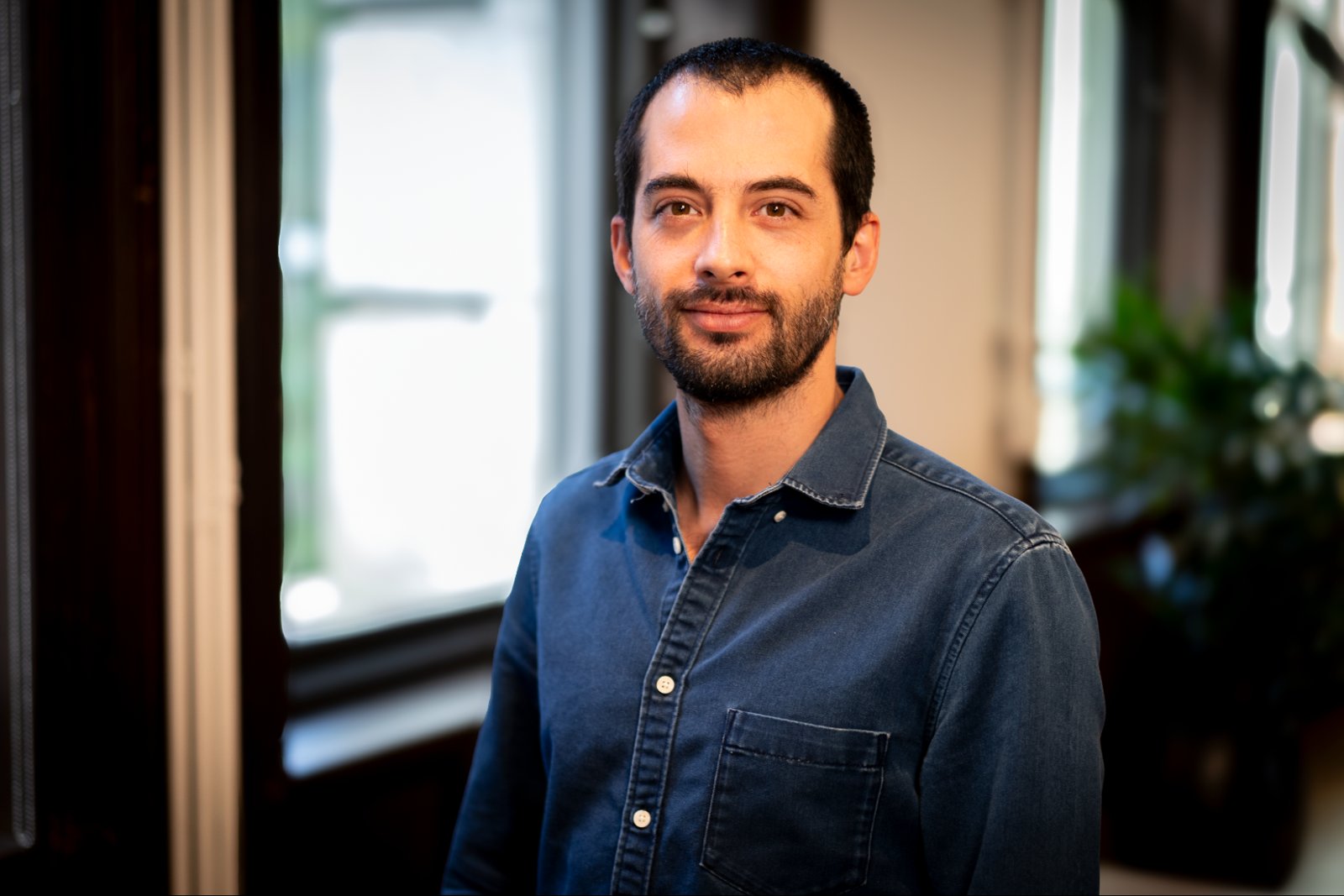
Gonzalo Benegas is a member of technical staff at Open Athena.
What do you like best about working here?
First of all, we have an amazing team. I'm really proud of that. I think everyone is really skilled at what they do, and they're also super curious about what each other is doing. You often get amazing ideas from people working in other domains that are fruitful for, for example, genomics. Overall, we are aligned on the mission to disseminate knowledge. This is a very noble goal and I’ve felt it throughout the places where I’ve worked. I think that desire for the search for truth is super, super strong here. And the idea that we also publish the failed experiments, that is extremely unique in my experience. This is another level of scientific rigor that is our practice at Open Athena.
What does a typical work day look like for you?
These days, there's always some agents that have been working overnight, so I go and check what they've been up to, in order to understand if they are on the right track with the right scientific question or the right implementation approach for an experiment. I can give them feedback.
Then I like to spend some time reading papers, which is a really different kind of mindset, from working with multiple agents to just focusing on a single reading. Changing my mindset is something that I sometimes need to make an effort to do, but it's something that I'm also pushing towards, towards keeping the habit of reading. There's always new ideas that pop up through reading—it’s really valuable.
Then we have meetings with the rest of the team, and we discuss how we've been working, especially now that we're working as a larger team within Marin for Science. It's really important that we collect our thoughts regularly.
And then there's the aspect of writing. Every now and then, we have to write the results of our experiments, like our blog post about MarinDNA. This is also an amazing way of consolidating thoughts about the project. It's something that, again, is going from working from multiple agents, back to a single focus of writing. That has also been super fruitful.
Do you have any favorite AI tricks or tips, whether for home or for work?
One thing that I'm trying to do right now is to connect my AI agents to all the different contexts that we have—from meeting notes to all the work that is on GitHub, the code repository, or on community sites such as Discord—to try to consolidate and synthesize what's going on every day. That is something I'm exploring.
Do you have a favorite piece of science trivia?
I'm not sure if it’s trivia, but there’s a story that I am very fond of. There's this person named Víctor Buso in Argentina, which is where I'm from, who decided to install a telescope in his home. And one night, he was able to see the first observation of a major astronomical event: the birth of a supernova. He contacted colleagues from Argentina, and also from around the world, and they ended up publishing a major paper about this. One thing that I like is that he made his discovery from home, so in this major journal, he put his affiliation as “Busonian Astronomical Observatory.”
Can you tell me about a hobby or activity you enjoy outside of work hours?
I really like being in the water. Throughout my life, I've been doing different kinds of sailing and surfing. Right now, my favorite ones are wing foiling, stand-up paddle foiling, and surfing. Depending on the conditions, there are a lot of different ways of navigating the water. With this kind of foiling technology, you can surf waves that are unbroken. So basically the whole ocean is yours. There are some cool runs between the islands of Hawaii that one can do, and I have ambitions of someday doing those.
Do you have a signature response emoji, or one you use most often?
One that I find myself using a lot more than average is the gem emoji, often when I see the writings of my colleagues. I’m really grateful for the quality of things that I can read.
Cite this post
@misc{bushwick2026_meet_our_team_gonzalo_benegas,
  author = {Bushwick, Sophie},
  title = {Meet Our Team: Gonzalo Benegas},
  year = {2026},
  month = {nov},
  howpublished = {\url{https://www.openathena.ai/blog/meet-our-team-gonzalo-benegas/}},
  note = {Open Athena Blog}
}